Pass It Around: The Secret Networks That Turned Jazz and Blues Into America's First Open-Source Art Form
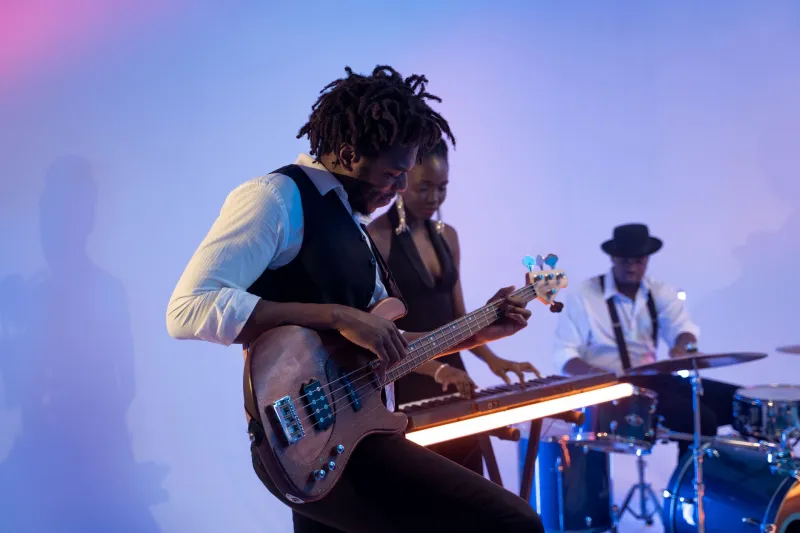
Forget the conservatory. Forget the record label. Forget the A&R rep with a clipboard and a contract. For most of the twentieth century, the real education in jazz and blues happened in kitchens, back alleys, cramped parlors, and smoky after-hours rooms where the only admission requirement was showing up with an instrument and the nerve to play it.
Musicians called these gatherings different things in different cities. Some called them jam sessions. Some called them cutting contests. In hip-hop culture, a similar circle of exchange would later be called a cipher — a loop of participants feeding off each other's energy, building something collectively that no single person could build alone. Whatever the name, the function was the same: a living, breathing network where knowledge moved freely and nobody held the keys.
Those networks didn't just shape individual careers. They built the entire architecture of American music.
Harlem Was the Hub
In the 1920s and 1930s, Harlem wasn't just a neighborhood. It was a clearinghouse. Rent parties — gatherings thrown to help a tenant cover their monthly bill — became one of the most important institutions in jazz history, and almost nobody planned it that way.
The setup was simple. You needed money. You threw a party. You charged a small door fee, maybe sold plates of food, and you hired musicians to keep the room moving. What nobody anticipated was how consistently those rooms would pull together players from wildly different backgrounds and styles. A stride pianist from Baltimore might find himself trading phrases with a New Orleans transplant and a kid fresh off the train from Kansas City, all in the same cramped Harlem apartment on a Saturday night.
Fats Waller, James P. Johnson, and Willie "The Lion" Smith weren't just performers at these events — they were nodes in a network, constantly absorbing and redistributing ideas. Young Duke Ellington sat in those rooms and listened before he ever led a band. The rent party wasn't a classroom, but it functioned like one, with the critical difference that no single teacher controlled the curriculum.
New Orleans and the Original Backroom Economy
Go back even further and you hit New Orleans, where the collaborative model was practically baked into the city's DNA. The musicians who came up in the Crescent City learned their craft in an environment that was, by necessity, communal. Funeral processions, dance halls, brothels, and church services all demanded music, and the players who worked those gigs were constantly in each other's orbit.
What made New Orleans different wasn't just the density of musical activity — it was the radical mix of influences feeding into it. African rhythmic traditions, French Creole harmonics, Spanish melodic sensibilities, and the Anglo-American hymn tradition were all colliding in real time. The musicians navigating that collision weren't theorists. They were practitioners, and the backroom sessions where they worked things out after the paying gigs ended were where the actual synthesis happened.
Louis Armstrong didn't emerge from a vacuum. He came out of a city that had spent generations building informal systems for passing musical knowledge from one generation to the next, from one community to the next, without gatekeepers deciding who was worthy of receiving it.
The Cutting Contest as Quality Control
Not everything about these networks was warm and collaborative. The cutting contest — where two or more musicians would go head-to-head, each trying to outplay the other — was the competitive engine inside the collaborative machine. And it worked.
In Kansas City during the 1930s, the after-hours jam sessions at clubs like the Reno Club and the Sunset Crystal Palace were legendary for their intensity. Charlie Parker, still a teenager, famously got embarrassed at one of these sessions early in his career — drummer Jo Jones reportedly threw a cymbal at his feet to signal that it was time to sit down. Parker went home, woodshedded for months, and came back transformed. The network had both humiliated him and motivated him. That's a feature, not a bug.
The cutting contest created accountability. You couldn't fake it in those rooms. Either your technique held up or it didn't, and the verdict was immediate and public. That kind of honest feedback loop is something that formal institutions, with their grades and their politics and their tuition-funded incentives to keep students enrolled, have always struggled to replicate.
Blues Networks Ran Differently, But They Ran Deep
The blues had its own version of this infrastructure, spread across a much wider geography. The Mississippi Delta, the Piedmont region of the Carolinas, the Texas roadhouse circuit — these weren't centralized hubs the way Harlem or New Orleans were. But the networks connecting blues musicians across those distances were just as real.
Itinerant musicians carrying songs from town to town functioned as the internet of their era, distributing musical information across hundreds of miles. Robert Johnson's mythology is built around a crossroads, but the more grounded truth is that he learned from Son House, who learned from Charley Patton, who absorbed techniques from musicians whose names we'll never fully recover. That chain of transmission is a network. It just didn't have a building.
The medicine show circuit, the juke joint scene, the church — all of these were distribution channels for blues knowledge. A guitarist who figured out a new tuning or a new way to bend a note would share it, sometimes deliberately, sometimes just by playing in front of other players who were paying close attention. The knowledge moved because the people moved.
What Modern Musicians Can Actually Take From This
It's tempting to romanticize these old networks and leave it there, but there's something genuinely instructive in how they operated that goes beyond nostalgia.
The jazz and blues cipher worked because it was low-barrier and high-accountability. Showing up was easy. Coasting was hard. The community set the standard and enforced it organically, without administrators or gatekeepers deciding who belonged.
Modern musicians have tools those earlier players never dreamed of — online communities, video sharing, direct-to-fan platforms, collaborative recording software that lets two players build something together from different time zones. But the technology is only as good as the culture it runs on. The rent party worked because the people in the room were genuinely invested in each other's development, not just their own visibility.
The open-source spirit that made those backroom sessions so generative wasn't accidental. It was a survival strategy born out of communities that had been systematically excluded from formal institutions. When the door to the conservatory is locked, you build something better in the kitchen.
America's greatest musical tradition didn't come out of classrooms or boardrooms. It came out of circles — loose, loud, ungoverned circles where the only currency was what you could play and what you were willing to share. That's a model worth keeping alive.