Old Ghosts, New Grooves: How Jazz Artists Are Mining the Blues for Tomorrow's Sound
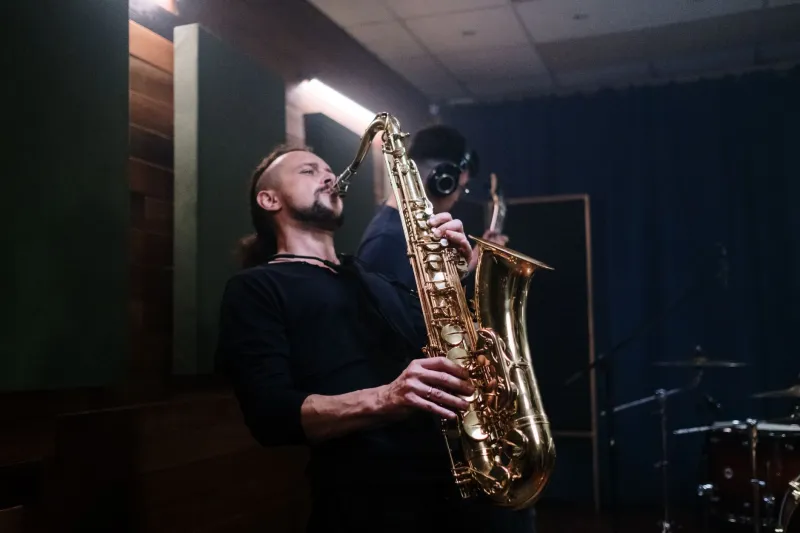
There's a moment in Marcus Elliot's studio in East Nashville where a scratchy 1940s field recording of a Delta bluesman fills the room, and then — almost without warning — a live saxophone curls around it like smoke. The two sounds shouldn't coexist. One is dry and ancient, full of tape hiss and open air. The other is warm, present, breathing. But together they lock into something that feels inevitable.
"I'm not trying to quote the blues," Elliot explains, leaning back in his chair with a coffee mug that's seen better days. "I'm trying to have a real conversation with it. Like calling up your grandfather and actually listening."
This is the bridge session — not a formal genre, not a movement with a manifesto, but a growing creative practice among contemporary jazz musicians who are reaching back into American music's deepest roots and pulling forward something entirely new.
Digging Through the Archive
The raw material is everywhere if you know where to look. The Library of Congress holds thousands of field recordings collected by Alan Lomax and others during the 1930s and 40s — unpolished, often crackling documentation of blues singers, work songs, and rural gospel captured on portable equipment across the American South. For decades, these recordings sat in relative obscurity, treasured by academics and hardcore collectors but largely unknown to general audiences.
Now, a generation of jazz artists is treating these archives like a record crate. Producers and composers are downloading, digitizing, and deconstructing these recordings with the same reverence a hip-hop producer might apply to a rare soul 45.
Chicago-based composer and bassist Dara Whitfield has spent the better part of three years building compositions around Lomax recordings and privately archived blues sessions. Her 2023 project Levee Songs used fragments of field recordings as rhythmic and melodic anchors for a full jazz ensemble. The results were layered and haunting — you could hear the creak of old wood in one track, a distant train whistle in another, all folded into live improvisation.
"The field recordings aren't just sonic material," Whitfield says. "They carry geography. They carry labor. They carry grief. When I bring those sounds into a modern composition, I'm asking my musicians to respond to all of that, not just the notes."
The Technical Side of Time Travel
Pulling this off isn't just an artistic challenge — it's a serious technical one. Vintage recordings come with noise, distortion, and pitch inconsistencies that can make integration into modern arrangements genuinely tricky. Producers working in this space have developed inventive approaches to bridging the gap.
New Orleans-based producer Jerome Tate, who has collaborated with several jazz ensembles on this kind of work, describes his process as "forensic listening." Before he touches a vintage recording, he spends hours isolating individual elements — a guitar string's attack, the breath before a vocal phrase, the natural reverb of a wooden room.
"Once you strip it down that far, you start hearing things that were always there but buried," Tate says. "A blues guitarist from 1938 might have this micro-rhythmic thing happening in his right hand that's basically proto-swing. I'll build an entire drum pattern around that. The modern drummer is essentially shadowing someone who's been dead for eighty years."
Spectral editing software and high-resolution digitization have made this kind of surgical work possible in ways it simply wasn't a decade ago. But Tate is quick to note that technology is just the tool — the artistic judgment about what to use and how to frame it is still deeply human.
Honoring Without Freezing
One of the tensions at the heart of this work is the question of authenticity versus innovation. Critics of the approach sometimes argue that layering modern jazz over vintage blues recordings risks flattening the original context — turning living history into aesthetic texture.
It's a fair concern, and the musicians working in this space are generally aware of it.
"I think the worst version of what we're doing looks like a museum exhibit," admits Elliot. "Where you put the old thing in a glass case and say, 'Look how cool this was.' That's not a conversation. That's a display." His response is to prioritize what he calls "active tension" — moments in a composition where the vintage material and the live playing are genuinely at odds with each other, where they push and pull rather than simply blend.
Whitfield takes a similar stance. Several tracks on Levee Songs deliberately leave the field recordings slightly out of tune with the ensemble, creating a productive dissonance. "You're supposed to feel the distance between those worlds," she says. "Because the distance is real. Pretending it isn't would be dishonest."
What It Sounds Like in the Room
Hearing this music live is a different experience from listening on record. At a recent performance at the Green Mill in Chicago — one of the country's legendary jazz rooms — Whitfield's ensemble performed alongside projected waveforms of the field recordings they were drawing from, the visual pulse of old sound running beneath the live music like a heartbeat.
The audience was mixed: older jazz regulars, younger listeners who might have stumbled in off the street, a few music students with notebooks. Between songs, Whitfield spoke briefly about the origins of the recordings — where they were captured, who was performing, what was happening in American life at that moment. It gave the music weight and context without turning the evening into a lecture.
"People stayed after," she recalls. "They wanted to talk about it. Not just about the music, but about the history. That feels like something."
The Lineage Keeps Moving
What makes this creative practice feel genuinely meaningful — rather than just novel — is the way it embodies something jazz has always done. The music has never been static. It absorbed blues, gospel, ragtime, and eventually rock, funk, and hip-hop, digesting influences and producing something new each time. This current moment is just the latest iteration of that restless forward motion.
The blues gave jazz its emotional core in the first place. These bridge sessions are, in a sense, musicians going back to the source and asking: what else is in here? What did we miss? What can we still learn?
Jerome Tate puts it simply: "The blues didn't end. It just kept changing forms. We're just one more form."
That lineage — from Delta cotton fields to Chicago studios to East Nashville apartments full of hard drives and vintage microphones — is American music in its truest sense. Messy, layered, alive, and always in motion. Jaxx Liberty was built for exactly this kind of story.


